William Knopf-Reflection
Distance learning has already changed throughout history. The original hand written correspondence has given way to the internet and other faster types of media. In the next 5-10 years the future of distance learning will become more acceptable. Siemens (2010) stated that just in the last 5 years the amount of traditional universities are offering some sort of distance learning courses, whether they are hybrid or fully off-campus courses.
When I become an ID I will show the value of the distance learning model. For example in my field of secondary education the need and use of distance learning is already increasing. In my classroom, all assignments are listed on Edline where the students have 24/7 access to the files and information that we cover in class. The students that are out of school will not lose the information, and can come back to the classroom not as far behind as before. One of the other areas that I see for distance learning is the GED programs and the alternative learning programs. For example when you have students that are trying to acquire the knowledge, but not in the traditional classroom the content is “watered down.” With distance learning there could be a teacher that teaches all the GED programs and alternative programs via the internet or webcam. This would allow those students the same opportunities as the students in the classroom.
The world is growing faster and faster each day. Technology is improving by leaps and bonds. The 21st century student will not need the same skills to master their workplace as our grandparents did. The traditional methods are effective and with the delivery styles such as blended instruction, those best practices can still be used and utilized. The one way to keep positive about distance learning is to show more and more people the benefits, and disadvantages. Research and best practices have shown that when you give the audience the true picture, they will make the most logical choice for themselves (Simonson, 2010). Personally I know that distance learning has made getting my Master’s degree possible. Distance learning has allowed me to continue my education with the flexibility that fits a crazy packed schedule. Since I am a teacher (middle school), coach 3 sports, have a family, and still can maintain a social life.
Sources:
Laureate Education (Producer). (2010). The Future of Distance Education. [Online]. Retrieved from Walden University eCollege.
Simonson, M., Smaldino, S., Albright, M., & Zvacek, S. (2009). Teaching and learning at a distance: Foundations of distance education (4th ed.) Boston, MA: Pearson
Friday, April 22, 2011

Saturday, April 16, 2011
Scenario- Trainer switches to distance learning
William Knopf-Training scenario
Scenario: A training manager has been frustrated with the quality of communication among trainees in his face-to-face training sessions and wants to try something new. With his supervisor’s permission, the trainer plans to convert all current training modules to a blended learning format, which would provide trainees and trainers the opportunity to interact with each other and learn the material in both a face-to-face and online environment. In addition, he is considering putting all of his training materials on a server so that the trainees have access to resources and assignments at all times.
• When converting a course to an online/distance learning experience planning is a huge concern and focus? According to Dr. Piskurich (2010) planning will take a major of the time when making a distance education course. The trainer will have to look at the very important items such as time, budget, objective parameters and course objectives (Piskurich, 2010). Another suggestion for the trainer would be to give surveys. The surveys would be an excellent tool to determine the technology level of the class and the learning abilities of the members in the class. Since learners have different abilities as well as different degrees of technology skills, this step would be extremely valuable. The trainer could make simple surveys using several websites. Such websites as Survey Monkey, Free online surveys, etc. From the results the trainer could then determine the best delivery method for the discussions. The technology survey would also give the trainer data to work with on regards to making the material available on a server, the learner’s abilities, and not making the technology a hurdle that the learners must fight to overcome. Since the trainer wants to place the information on a server, servers will have to be researched as well. Services such as Free Webspace, or even a list of free web services. Another suggestion for the trainer would be to use any of the CMS and LMS that are online. This will allow the trainer to track and keep better records of the efforts from the trainees. There are a variety of free CMS, LMS available. Here is a list that are available 15 desks, Ectolearn, Lecture Share, School Rack, rCampus, Moodle, Edmodo, and edu2.0.
• What aspects of his original training program could be enhanced in the distance learning format? The original program can be enhanced with distance learning by making the program have more activities. Since the biggest problem that the trainer is seeing is communication, the trainer could use discussion boards, blogs, instant messaging, and multimedia. The trainer also stated that they wanted to place their course files online so they can be accessed at any time. By placing the files online, the trainees could access them before the face-to-face setting making the course time more valuable. The better prepared the trainees are before they come into the face-to-face setting, the better the discussions in class could be, as well as the information from the trainer would not be totally new.
• How will his role, as trainer, change in a distance learning environment? In the distance learning environment the trainer’s role would change from an instructor to a facilitator. If the trainer decides to use discussion boards, blogs, etc he will need to follow the rule of thumb for discussions. The rule of thumb for discussion is 1:4 (Simonson, 2009) when interacting or replying to the online discussions. Keeping to this ratio will allow the trainees to learn from each other and the discussions will become more valuable. In the distance environment setting the trainer would be more of a supervisor of the discussions. The trainer would look over the discussions and make sure that there is correct dialogue being given and correcting information that was incorrect (Simonson, 2009).
• What steps should the trainer take to encourage the trainees to communicate online? To encourage the trainees to communicate online, the trainer could make the first discussion a getting to know you discussion. This would be more open and allow the trainees to share something about them. The trainer should have the same requirements for this discussion, so the trainees could get used to the format and expected style. Another idea would be for the trainer to be the first one to post in that discussion. This would give the trainees a piece of information about the trainer that they might not have gotten from the face-to-face course.
Sources:
Laureate Education (Producer). (2010). Facilitating Online Learning. [Online]. Retrieved from Walden University eCollege.
Simonson, M., Smaldino, S., Albright, M., & Zvacek, S. (2009). Teaching and learning at a distance: Foundations of distance education (4th ed.) Boston, MA: Pearson


Scenario: A training manager has been frustrated with the quality of communication among trainees in his face-to-face training sessions and wants to try something new. With his supervisor’s permission, the trainer plans to convert all current training modules to a blended learning format, which would provide trainees and trainers the opportunity to interact with each other and learn the material in both a face-to-face and online environment. In addition, he is considering putting all of his training materials on a server so that the trainees have access to resources and assignments at all times.
• When converting a course to an online/distance learning experience planning is a huge concern and focus? According to Dr. Piskurich (2010) planning will take a major of the time when making a distance education course. The trainer will have to look at the very important items such as time, budget, objective parameters and course objectives (Piskurich, 2010). Another suggestion for the trainer would be to give surveys. The surveys would be an excellent tool to determine the technology level of the class and the learning abilities of the members in the class. Since learners have different abilities as well as different degrees of technology skills, this step would be extremely valuable. The trainer could make simple surveys using several websites. Such websites as Survey Monkey, Free online surveys, etc. From the results the trainer could then determine the best delivery method for the discussions. The technology survey would also give the trainer data to work with on regards to making the material available on a server, the learner’s abilities, and not making the technology a hurdle that the learners must fight to overcome. Since the trainer wants to place the information on a server, servers will have to be researched as well. Services such as Free Webspace, or even a list of free web services. Another suggestion for the trainer would be to use any of the CMS and LMS that are online. This will allow the trainer to track and keep better records of the efforts from the trainees. There are a variety of free CMS, LMS available. Here is a list that are available 15 desks, Ectolearn, Lecture Share, School Rack, rCampus, Moodle, Edmodo, and edu2.0.
• What aspects of his original training program could be enhanced in the distance learning format? The original program can be enhanced with distance learning by making the program have more activities. Since the biggest problem that the trainer is seeing is communication, the trainer could use discussion boards, blogs, instant messaging, and multimedia. The trainer also stated that they wanted to place their course files online so they can be accessed at any time. By placing the files online, the trainees could access them before the face-to-face setting making the course time more valuable. The better prepared the trainees are before they come into the face-to-face setting, the better the discussions in class could be, as well as the information from the trainer would not be totally new.
• How will his role, as trainer, change in a distance learning environment? In the distance learning environment the trainer’s role would change from an instructor to a facilitator. If the trainer decides to use discussion boards, blogs, etc he will need to follow the rule of thumb for discussions. The rule of thumb for discussion is 1:4 (Simonson, 2009) when interacting or replying to the online discussions. Keeping to this ratio will allow the trainees to learn from each other and the discussions will become more valuable. In the distance environment setting the trainer would be more of a supervisor of the discussions. The trainer would look over the discussions and make sure that there is correct dialogue being given and correcting information that was incorrect (Simonson, 2009).
• What steps should the trainer take to encourage the trainees to communicate online? To encourage the trainees to communicate online, the trainer could make the first discussion a getting to know you discussion. This would be more open and allow the trainees to share something about them. The trainer should have the same requirements for this discussion, so the trainees could get used to the format and expected style. Another idea would be for the trainer to be the first one to post in that discussion. This would give the trainees a piece of information about the trainer that they might not have gotten from the face-to-face course.
Sources:
Laureate Education (Producer). (2010). Facilitating Online Learning. [Online]. Retrieved from Walden University eCollege.
Simonson, M., Smaldino, S., Albright, M., & Zvacek, S. (2009). Teaching and learning at a distance: Foundations of distance education (4th ed.) Boston, MA: Pearson


Saturday, April 2, 2011
Open Course Assessment


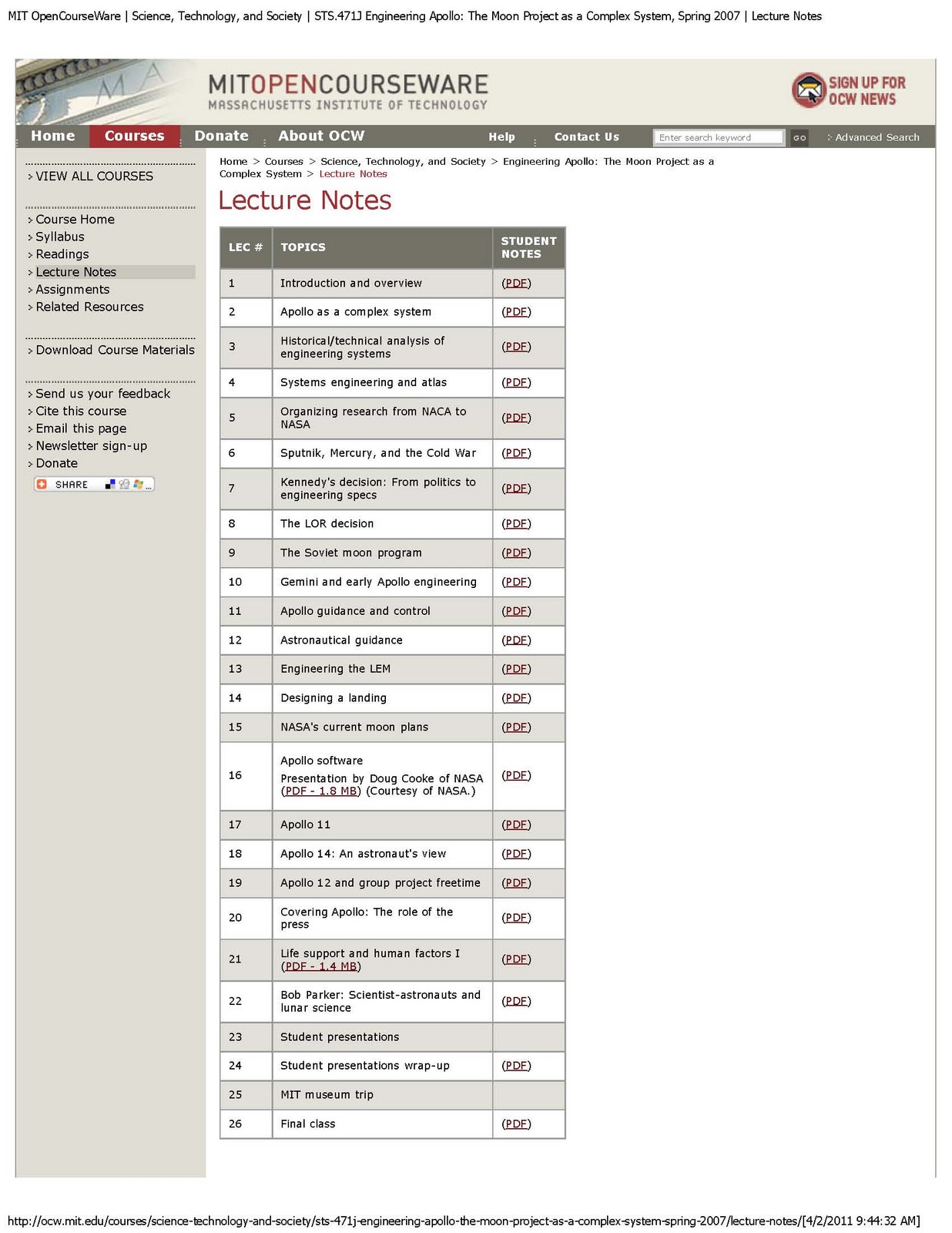


http://ocw.mit.edu/courses/science-technology-and-society/sts-471j-engineering-apollo-the-moon-project-as-a-complex-system-spring-2007/
I selected for the Open Course website review MIT and the course on engineering Apollo: The Moon Project a Complex System. The reason that I selected the course was because my class that I teach is about to enter into the Rocketry section of the year. This is a very exciting and eye opening section that the students seem to get very involved with.
Analysis of Open course-Looking at the site more critically I was looking for planning of the course/website and how it was laid out for the learner. The course has the layout and design of a typical online course. On the left hand side there are hyperlinks to all the different areas that are important to the course and to the learner (syllabus, readings, lecture notes, assignments, related resources, and download-entire course materials). Once you select the hyperlink that you are looking for it takes you to a different page where all the materials are laid out in an easy to read format, the font is approximately 20-24 font which is easy for the learner to read (Simonson, 2009). The text and titles are in different colors to indicate which is which (red-title & black-text). The course is well designed and the assignments are linked well to the syllabus and the lecture notes. It is well designed and organized and each “lesson” is linked to its assignment, notes, and resources. The resources are full of videos and media to enhance the course, not hinder them.
According to Dr. Piskurich (2010) this type of course would be asynchronous learner led course that is the 5th best choice for a course delivery style. This type of course would be highly dependent on the learner’s motivation. The course would be better for the learner if there was some sort of interaction between the instructor and the learner. However I do understand why it does not, the course is a free course, and thus no one is getting paid to lead it, grade the assignments, or delivers the material. The objectives of the course are not clearly defined and to make this course better that would need to be added. According to both Dr. Piskurich (2010) and Simonson (2009) the objectives have to be clearly stated and related to the needs of the learner. The activities that are related to the course are designed to make the learner think cognitively about the information that they processes and relate that information to the assignment/course project. Dr. Piskurich (2009) believes that one of the best ways to make the activities link to the objective is to use small groups leading to the large group. In the team project the learners are broken into smaller groups and they will display their projects to the entire class. The project is directed yet flexible enough to allow for the learners to show creativity and grasping of the objective (Piskurich, 2010).
Sources:
Laureate Education (Producer). (2010). Planning and Designing Courses. [Online]. Retrieved from Walden University eCollege.
Laureate Education (Producer). (2010). Developing Online Courses. [Online]. Retrieved from Walden University eCollege.
Simonson, M., Smaldino, S., Albright, M., & Zvacek, S. (2009). Teaching and learning at a distance: Foundations of distance education (4th ed.) Boston, MA: Pearson
Saturday, March 19, 2011
Distance Learning Scenario
Scenario-A high school history teacher, located on the west coast of the United States, wants to showcase to her students new exhibits being held at two prominent New York City museums. The teacher wants her students to take a "tour" of the museums and be able to interact with the museum curators, as well as see the art work on display. Afterward, the teacher would like to choose two pieces of artwork from each exhibit and have the students participate in a group critique of the individual work of art. As a novice of distance learning and distance learning technologies, the teacher turned to the school district’s instructional designer for assistance. In the role of the instructional designer, what distance learning technologies would you suggest the teacher use to provide the best learning experience for her students?
To help the history teacher out with this project the technologies that I would suggest would be an interactive tour and a web-quest. After the teacher has introduced the lesson, she could build a web-quest for her students. (see below) A web-quest is similar to a worksheet that is solved by going to various websites to locate the answer. A web-quest can easily be made, differentiated, and completed with basic computers. Even if the teacher is not familiar or unsure about making a web-quest, a very simple search using Google or Bing (see below)can deliver thousands of examples or ones that other teachers have used. I have personally used and created many web-quests and the students enjoy them.
Once the web-quest is complete she could send her students on an interactive tour of the museum. Since she wants to have her students interact with the museum curators setting up a webcam or Skype would allow them to have real-time conversations. Another option to have synchronous communication would be to setup a discussion board where the students could log on and post comments to the curators to comment back. Using the http://www.metmuseum.org/explore/museumkids.asp will take her students to the museum’s main page(see below). While in communication with the curator, the students could navigate the museum, pausing for questions and still seeing the major exhibits without leaving their classroom.
A more self guided tour would use http://www.moma.org/interactives/destination/# will actually take her students to the museum of modern art in New York City. The tour is animated, yet has the abilities to focus on pieces of art. From this site she could assign various paintings for her students to discuss or even have activities with (see below). This site allows the students to use other intelligences to examine and manipulate the paintings, while learning about the pieces of art. With some practice, trial and error the teacher should become more familiar with using the technologies to enhance her lessons.


To help the history teacher out with this project the technologies that I would suggest would be an interactive tour and a web-quest. After the teacher has introduced the lesson, she could build a web-quest for her students. (see below) A web-quest is similar to a worksheet that is solved by going to various websites to locate the answer. A web-quest can easily be made, differentiated, and completed with basic computers. Even if the teacher is not familiar or unsure about making a web-quest, a very simple search using Google or Bing (see below)can deliver thousands of examples or ones that other teachers have used. I have personally used and created many web-quests and the students enjoy them.
Once the web-quest is complete she could send her students on an interactive tour of the museum. Since she wants to have her students interact with the museum curators setting up a webcam or Skype would allow them to have real-time conversations. Another option to have synchronous communication would be to setup a discussion board where the students could log on and post comments to the curators to comment back. Using the http://www.metmuseum.org/explore/museumkids.asp will take her students to the museum’s main page(see below). While in communication with the curator, the students could navigate the museum, pausing for questions and still seeing the major exhibits without leaving their classroom.
A more self guided tour would use http://www.moma.org/interactives/destination/# will actually take her students to the museum of modern art in New York City. The tour is animated, yet has the abilities to focus on pieces of art. From this site she could assign various paintings for her students to discuss or even have activities with (see below). This site allows the students to use other intelligences to examine and manipulate the paintings, while learning about the pieces of art. With some practice, trial and error the teacher should become more familiar with using the technologies to enhance her lessons.


Saturday, March 5, 2011
Week 1


After reading/watching the resources this week, it was apparent that I underestimated the time that distance learning has been available. I was under the impression that it was mostly talking about online and computer aided instruction. But I failed to realize is that distance learning has been going on since the early 1800’s (Timeline). Then once I got a reality smack in the face I started to remember the stuff that we did in grade school. I remember the learning of English from a satellite TV program. I can also remember listening to stories on the radio (recorded) that our teacher played for us. Looking at the way things have evolved over the years, it is still amazing how things have stayed the same. The four basic components to the definition of distance learning helps give me the picture that I saw as today and relate it to yesterday. The four key components are: institutionally based; separation of teacher and student; interactive telecommunications, sharing of voice, data, and video (Simonson, 2009).
What I see as the potential benefits to my current position (8th grade Science) is the ability to deliver information and the WOW factor all at once. One of the hardest things to show and teach is the atom, for example. Now with the laptops that my students have they can search the internet, watch a streamed video, and use an interactive website to manipulate the parts of an atom (otherwise impossible). Another benefit to distance learning is that I am able to take graduate classes with the busy schedule that I have. Not only am I a teacher, but I also have a family, coach 3 sports, referee, and workout every day. In the traditional setting one of these items would have to suffer for me to get an education, I would have to sit in a classroom and lose hours per day (which I don’t have).
What I see as potential challenges is the technology itself or access to it. Most people have a computer today, and they are becoming more affordable every day. Even with the computer you still need internet access to take an online class, search for information, participate in discussion boards, etc. Another challenge is making the course interesting yet flexible, as well as academically challenging enough. The need for teachers/professor to teach in this untraditional environment is also a challenge. Another challenge that is over looked is academic dishonesty. With the “learner” not being in direct face/face contact with the teacher, there are more chances that dishonest academic behavior is occurring. To counteract this software is being developed and implemented that check for academic dishonesty in papers and discussion (Turnitin). Dr. Simonson (2009) stated that distance learning is and will grow exponentially, however it will not abolish traditional learning. In our last class I did a research project on just that “Replacing traditional instruction methods with computer aided instruction.” I found from my research that a blended instructional model is still the most preferred and effective. In my own room I use a mix of both as well. Overall distance learning has more advantages then disadvantages, thus the reasons it has survived and evolved from the 1830’s.
The future of distance learning in my opinion will be more blended instruction. As the schools today become more available to students not in the classroom, a new method will be needed to accommodate the need. With society’s changes, distance learning can bring the traditional classroom into the global classroom; allowing classes to be accessed from anywhere, cooperative learning, web casting to foreign lands, states, connecting cultures across the country & globe.
Source:
Distance Learning Timeline Continuum [Multimedia]. (2011). Walden Library.
Simonson, M. R. (2009). Teaching and learning at a distance: foundations of distance education. Boston: Allyn & Bacon/Pearson.
Simonson, M.R. (2010). “Distance Education: The Next Generation.” Walden Video Library.
Tuesday, March 1, 2011
The story of an ID.....
Using blogs is a good way to stay connected. It does require discipline to check your blog, not just the discussion boards! I will have to add this to my routine and after 14 times it will be a habit! Great!
Where you invest your love, you invest your life! Think about that one!!
Where you invest your love, you invest your life! Think about that one!!
Subscribe to:
Posts (Atom)